
Growing Old Alone
Not as bad as you might think

More than 30 years ago, when I was about 42 and going through my one and only divorce from my one and only husband, my mother said to me, “I’d hate to see you grow old alone.”
Well, guess what, Mom? I’m almost 75 and that seems to be what’s happening.
And it’s not like I planned it this way. As those of you who have followed me on Substack may remember, I published a series called “Rotten Romance” about the many dates and relationships I endured and sometimes enjoyed following the split from Mr. Landi. There was only one man I fell seriously in love with, and I moved lock, stock, and pussycat 3,000 miles away to set up housekeeping with him in Seattle and co-host a radio show in Portland. I now call it “The Year of Living Stupidly.”
Since then, there have been dates and hopes and more failed romances. My last set of encounters with the opposite sex with an eye to mating in a long-term way was shortly before the pandemic, when I met a possible match on a dating site and after three or so meetings decided maybe it was time to rumple the sheets, as it were. When I suggested we check out the chemistry, he demurred: “I’ve already got a girlfriend.”
“Then why the hell did you hit on me?
“Everyone has the right to look for love!”
There’s really no appropriate answer to this other than to hang up.
And so, like everyone else, I suffered through the pandemic, relying mainly on Zoom meetings and the occasional in-person, heavily masked encounter on safe turf. It wasn’t so bad. And then I got busy with the gallery and caught Covid for real nearly three years ago, and as I have whined repeatedly, that’s been an ongoing difficulty.
But living alone? Growing old alone? Not really my choice. But I don’t feel any huge deprivation, and I often quite enjoy the solitude. One of the reasons Marcel Duchamp has always been a favorite artist of mine is that he occasionally welcomed chance as part of his artistic process. Three Standard Stoppages (1913-14), for example, were made when the artist dropped three meter-long threads onto three stretched canvases, which he pasted to the ground to preserve the random curves they assumed upon landing. “The canvases were cut along those curves, creating a template for new units of measure that retain the meter’s length but undermine its rational basis,” according to the Museum of Modern Art’s website. It remains an enigmatic and elegant work, with its own neatly designed box.
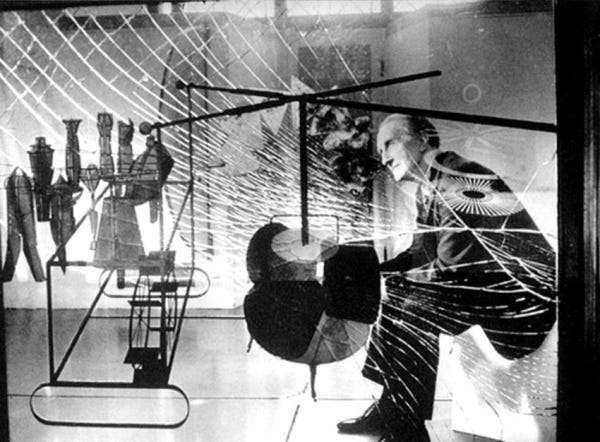
Duchamp was reportedly unperturbed when his masterpiece The Bride Stripped Bare by her Bachelors, Even (known as “The Large Glass”), an assemblage of thrillingly arcane symbols, was damaged in transit, its glass exterior badly cracked and splintered. He calmly glued the pieces back together and was happy to have it shown as is.
I bring up chance because it’s a notion many don’t like to entertain or accept, but it begins from the moment your dad’s sperm met your mom’s egg (or your parents hired a surrogate or adopted you from a foster home). There are simply events over which we have no control. Like a spouse’s sudden death or incurable cancer or getting reamed by a drunk driver or losing a job or having your house burned down or the toilet backing up….or whatever.
But I know what my mother meant, because she was never sure I could survive without a man to “protect” me. Neither was I. I didn’t seek out my current single status.
In an unexpected turnabout, the only couple I watched grow old together, up close and personal, were my parents. And it was not a fun experience. My mother retired too soon, at the age of 62, from a job she dearly loved as a children’s librarian in a New York private school. My father, two years older, wanted to drink to excess and read the Times every day until he landed in the hospital with a stroke. He recovered, but not fully. It was my dad’s idea to give up their Manhattan apartment and move to Florida. My mother found herself in strange territory, among corporate wives and golfers (she never played and had no interest in learning). She became depressed and went on Prozac. Increasingly, the two of them sniped at each other, low-level fusillades that were sometimes amusing. (When he failed to shower regularly, she took to calling him “old Roquefort.”)
Their house went to hell as my father refused to call the building’s management and attempted repairs himself. The pool remained unused; huge June bugs skittered about the kitchen floor. My parents did have a housekeeper, so the premises were regularly cleaned. There was only so much I could do to help out when visiting two or three times a year (my brother and his wife refused to fly there from Kansas, until my mother was in hospice).
As for taking care of each other—yes, they did as much as possible. My mother’s body became increasingly frail from heart problems, COPD, and osteoporosis. But her mind remained alert. My dad’s brain was sliding toward ever deeper dementia, but he could get her to the doctor or the hospital. And she did as much as she could for him. I argued for assisted living when I visited, but my dad dismissed the idea: “We don’t think we’d like those kinds of people.”
So it does not strike me that having a partner is any guarantee of a happy old age. I do know married couples, still together after decades, who obviously enjoy each other’s company, are proud of having raised kids and stayed in the union, who might indeed walk hand in hand into the sunset. And I often miss having a partner—the daily conversation, a gentle touch (sex not so much, but I have amazingly horny dreams. Where else would I be doing it with Dominic West against a paneled wall in Buckingham Palace?).
But the statistics about older women living alone tell the real story. “There are roughly 30 million women aged 70 and older in the U.S. (estimate based on demographic age distributions),” says my friendly chatbot. “If approximately 35–40% of these women live alone, that suggests about 10.5–12 million women age 70+ living alone in the U.S. population.”
So there are a lot of us out there, and one way or another we are coping—through friendships, online support groups, a long-distance correspondence with an old beau, and of course pussycats.
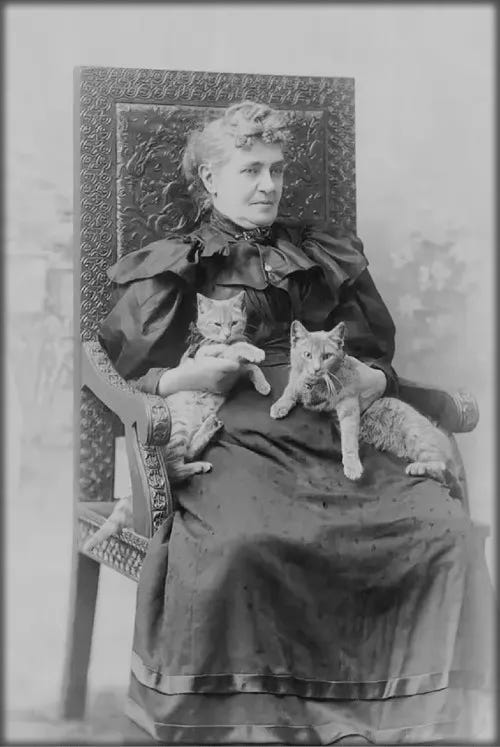
I didn’t intend to wind up that worst of stereotypes: An old woman living alone with a cat.
I wanted to be a rich old lady with a villa in Tuscany and a couple of handsome pool boys at her beck and call.
Fate—and chance—had other plans.
Lovely and lively and true and funny. Thank you!🙏 😊
Yes, not so bad after all. It's what my sister and I talk about a lot (she is 82, me 84, both artists, divorced twice and like to be alone etc.) I do miss, as do you, cuddling, talking, sharing humor and an approach to life...but not much of anything else really. If I could get my dear cat to scratch my back and cook, well, that would be heaven.
(Quote on the wall to my studio)
"In the past few years she had let go her ties to people she did not like, to ironing, to dining out in town, and to buying things not necessary and that themselves needed care. She ignored whatever did not interest her. With those blows she opened her day like a pinata. A hundred freedoms fell on her. She hitched free years to her lifespan like a kite tail. Everyone envied her the time she had, not noticing that they had equal time."
Annie Dillard from her book "The Maytrees"