
Hockney's Optics
Did the old masters "cheat"?


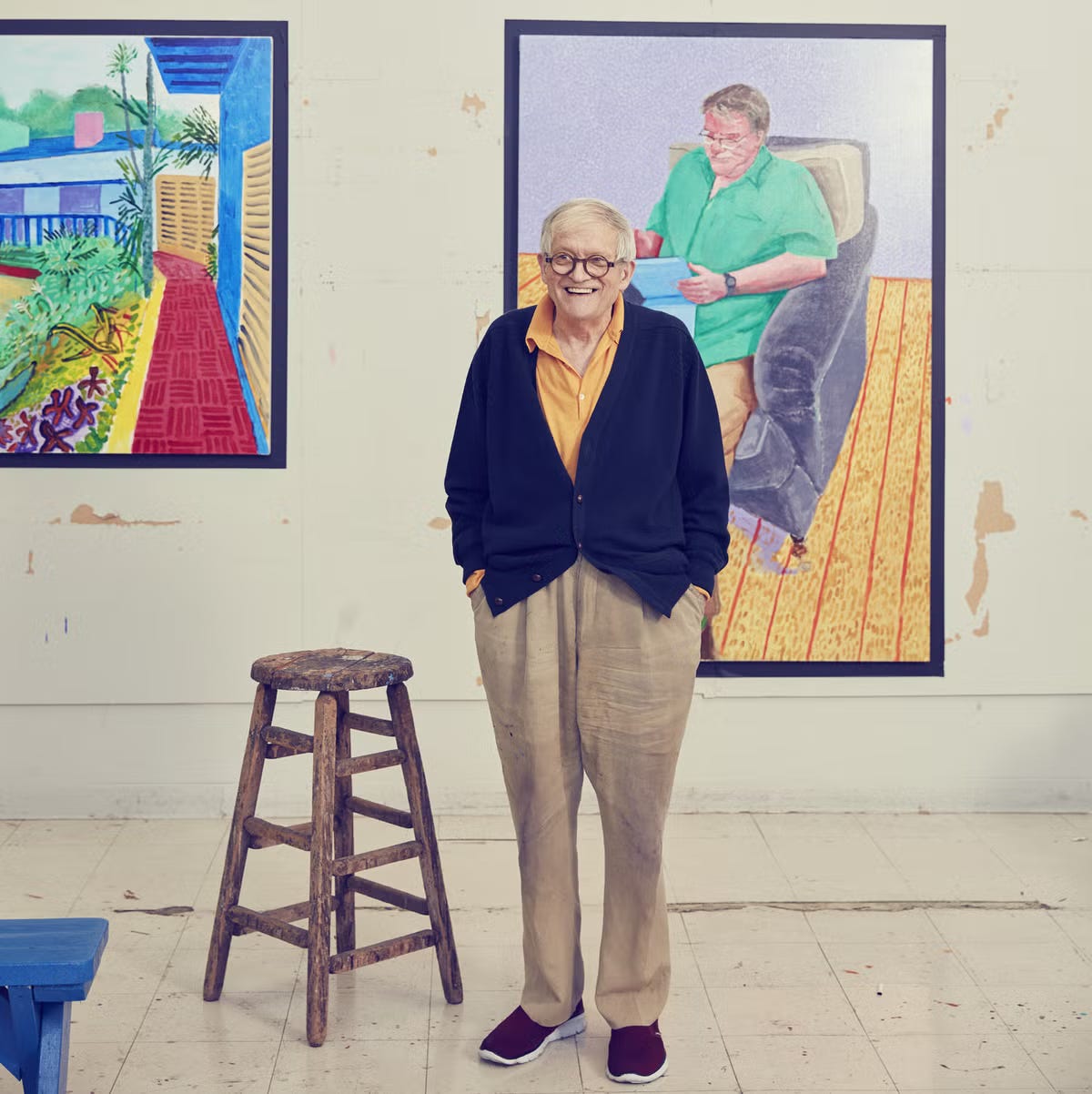
The death of the greatly admired and beloved David Hockney on June 11th inspired an outpouring of tributes and provoked in me a recollection of an hour-long conversation I had with the artist in 2001, on the cusp of the publication of his book Secret Knowledge: Rediscovering the Lost Techniques of the Old Masters. In its pages, Hockney argued that the old masters used optical devices such as the camera obscura, the camera lucida, and lenses to achieve a high degree of accuracy in their works.
I was working on the story for ARTnews at the time, asking around among art historians what they thought of Hockney’s theories (the consensus was about evenly split), and so it now seems worth looking at again—both in light of Hockney’s passing and fears that artificial intelligence will make increasing inroads into the realm of creativity, to the chagrin of artists and art lovers alike.
Happily for me—and you—Laurie Fendrich, our critic at large, took a careful look at the subject two decades ago for The Chronicle for Higher Education, and I present her lucid and thoughtful conclusions (edited slightly) here. It’s a long one, but well worth your time. AL
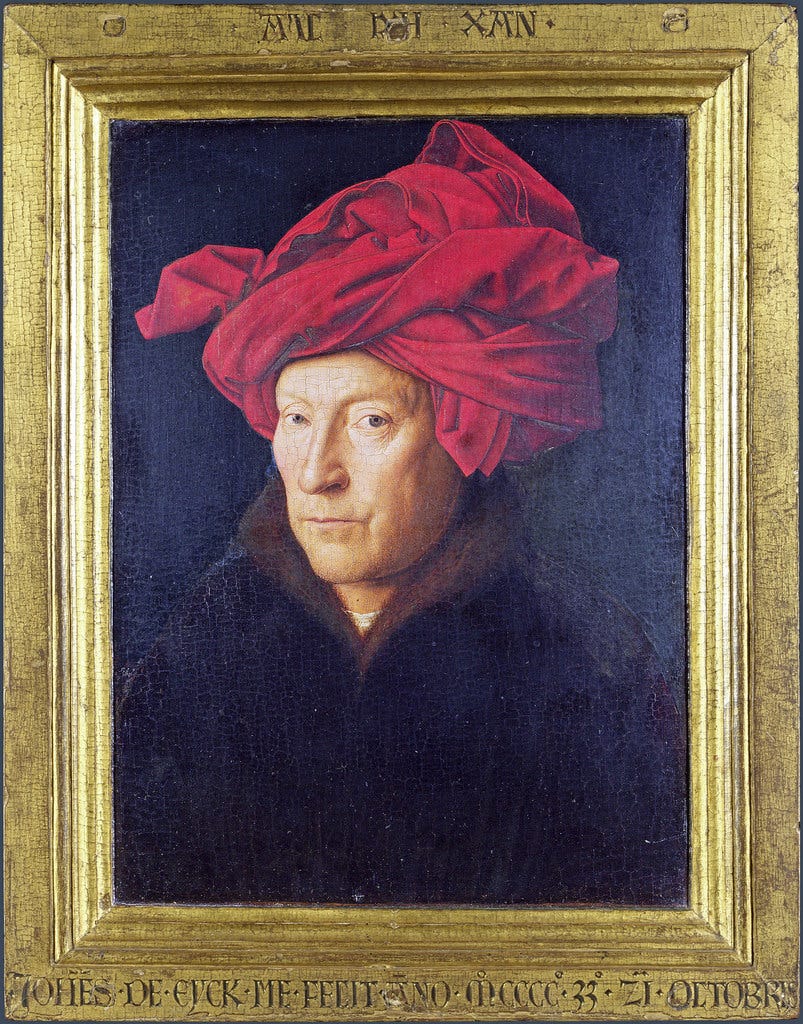
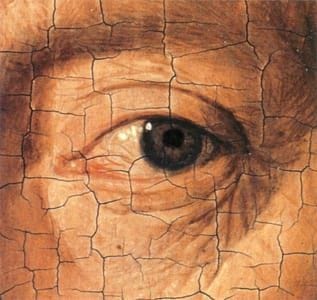
Several years ago, I stood holding my breath in the National Gallery in London, my eyes not ten inches from Jan van Eyck’s Portrait of a Man. Painted in 1433, it’s a small picture, about ten by seven inches. For any painter, including an abstract painter like myself, there’s a tingle that comes from being so close to such a painting. No intermediary is necessary, and none is present. The thrill of the painting is that it comes to you, perceptually, directly from the artist, almost as if it came off the easel that very day.
How did he do it? Did he really use a one-haired brush? Even if he did, what talent allowed him to get all those tiny details so perfectly? How did he so deftly fit the proportion of the parts of the face into the whole? How did he get the effect of the roundness of the head, and achieve a sense of air around it? What kind of eye and hand achieved that touch, that light, those transparencies, those colors? And into the black space surrounding that painted face, which many suggest is a portrait of Jan van Eyck himself, he delicately yet clearly inscribed the words Als ich can—“The best that I am capable of doing.”
This little painting, and its motto, to me stands for all great painting. If a mortal human being can make this kind of beauty, then the Greeks were right: We are partly gods. The best of us can create wonders that cast a splendor on the brief existence of the rest of us. The painting elicits a sense of awe in nearly everyone who sees it. We understand it to have been drawn freehand, from the artist’s observation of the real world—“eyeballed,” as the contemporary British painter David Hockney calls it.
But 25 years ago Hockney proposed a startling theory to account more prosaically for such art: Starting around 1430, artists had help, in the form of lenses, that enabled them to get proto-photographic projections of their three-dimensional subjects onto their two-dimensional panels, canvases, and sheets of drawing paper before they started to paint or draw. In his book, Secret Knowledge: Rediscovering the Lost Techniques of the Old Masters (Viking), and in the BBC-produced film, “David Hockney’s Secret Knowledge” (broadcast in Britain in October 2001), Hockney argues that Jan van Eyck and other old masters, including Holbein, Vermeer, Hals, Velázquez, Rembrandt, and Caravaggio, used more tools than their eyes, hands, and brushes to achieve their astonishing pictorial realism. Hockney, whose argument is supported by the forensic math of his friend Charles Falco, a physicist and professor of optical sciences at the University of Arizona, claims that one can see all this just by looking carefully at the pictures.
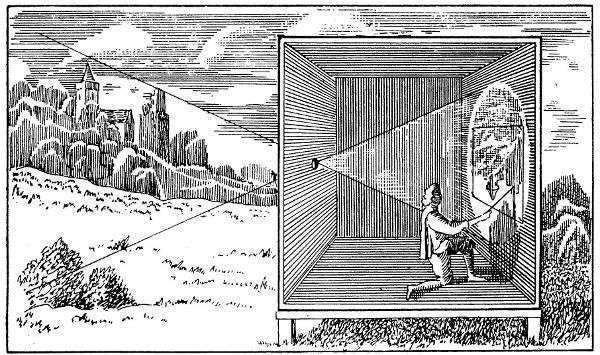
According to Hockney, the sudden appearance around 1430 of a drastically heightened realism in European painting is largely explained by the use of lenses. He says that artist-used lenses first showed up in Brugge (present-day Bruges), in Flanders, but quickly spread to Florence and beyond. At first, these lenses were concave mirrors, followed by the camera obscura, literally a “dark room” with a small hole in one wall. With strong enough light coming from the outside, an image of something out there could be projected (albeit upside down) onto an opposite wall. In the 1600s came lenses like the kind in telescopes, which were then inserted into the holes of camera obscuras.
Now, art historians have known that artists in the 17th century used lenses, but to what extent they were used has been unclear. For his book Vermeer’s Camera: Uncovering the Truth Behind the Masterpieces (Oxford University Press, 2001), Philip Steadman, an architect and an expert in computer-aided design, constructed actual models and studied the perspective geometry of Vermeer’s paintings. He concluded that Vermeer used the camera obscura not just as an optical aid (as the art historians Lawrence Gowing and Walter Liedtke both argue), but as a veritable booth in which he sat and traced the entire outline of at least ten of his paintings.
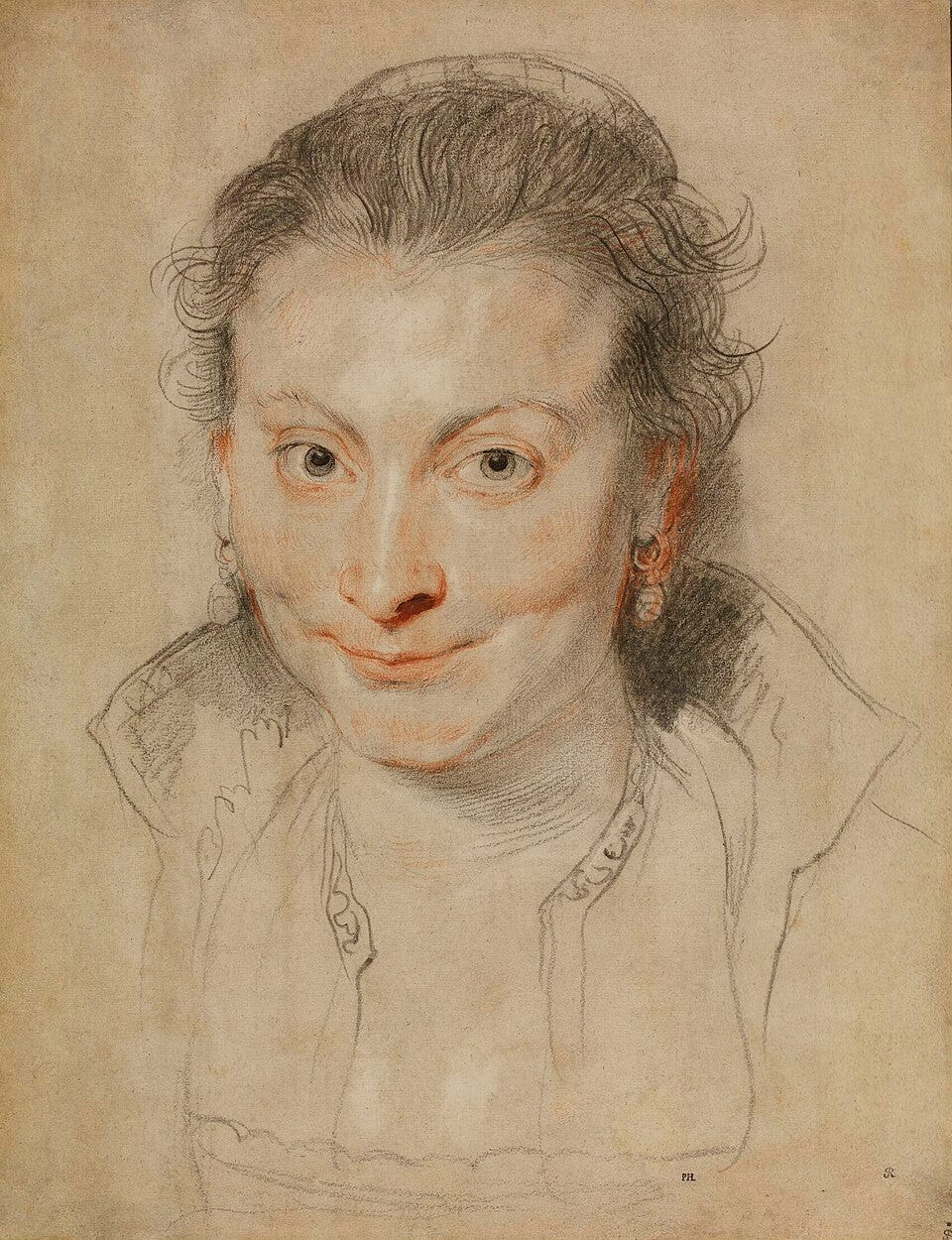
Hockney goes even further. In essence, he argues that artists started using lenses about 200 years earlier than Vermeer, and that lenses were used much more widely than previously thought. Hockney admits that not all old master painters used lenses (Rubens among them, for example). But he concludes that in many cases, lenses were as important, if not more important, than artists’ training and talent in observing and depicting the physical world around them. Lenses, in other words, accounted for the Renaissance’s great leap forward in painterly verisimilitude.
To understand fully the revolutionary nature of Hockney’s theory, it helps to know that not one of the major art history textbooks now commonly used in American art history survey courses—Marilyn Stokstad’s Art History, Helen Gardner’s Art Through the Ages, or H.W. Janson’s History of Art—contains the word “lens” in the index. The word “mirror” appears in some books, but never in the context of its use as a lens. According to Falco, Hockney’s discoveries concerning lenses would have been made by somebody else ages ago if art historians had been routinely educated in the science of optics; they then would have known that concave mirrors function as lenses. In other words, art historians were asleep at the wheel and have once again allowed the sentimental humanities to be embarrassed by hard-headed science.
But few art historians concurred with Hockney’s hypotheses at a standing-room-only symposium I attended in 2001 at the New York Institute for the Humanities. In fact, many on the star-studded panels and in the audience weren’t buying it at all.
Now, I lay no claim to understanding the physics involved in Hockney’s theory. But after listening to all the panelists, pro and con, reading Hockney’s book, watching a tape of the BBC program, and reading rebuttals from art historians, critics, and artists on the Internet and elsewhere, I’m almost completely convinced that Hockney is right that artists used lenses. What surprised me at the symposium, however, was the implicit denial on the part of everyone—supporters of Hockney’s theory and naysayers alike—that Hockney’s theory, if true, might have negative consequences for painting, art appreciation, art history, or culture in general.
That nonchalance came in four flavors, which might be described as: (1) “No big deal. Moreover, it’s not all that interesting, so let’s get on with looking at the paintings for aesthetic pleasure”; (2) “I’ve known this all along—see my publications on the subject”; (3) “Optics are a neat tool, but well-trained, skilled artists, especially those with the rigorous drawing training that was normal in the Renaissance, didn’t need them, because they can do this kind of complicated stuff without lenses”; and (4) Hockney’s own motto, “Optics don’t make marks” (meaning, “Don’t get hung up on how the lines on a canvas were made; all that matters is what’s between the lines”—i.e., the artist’s touch).
There was a general consensus, in short, that tools are tools, tools are neutral, artists have always used whatever tools were available to them, and there is no moral or aesthetic issue involved if they did a lot of tracing.
But I think that there are larger implications to Hockney’s theory, assuming it is right, and that it will cause serious cultural damage. Let me begin with the idea that Hockney’s theory is neither a big deal nor all that interesting. On the contrary, it shakes the foundations of much of art history, as well as realist painting as an art form. Learning that artists used lenses extensively in the 1400s shifts the “photographic” flat image from a minor, late-game player in Western art to a member of the starting lineup. And when it comes to the aspirations of young artists who want to make realist paintings like the old masters, it casts a pall. It becomes reasonable for them to wonder if they, too, shouldn’t use lenses in their drawing and painting. More important, it subverts the way that most of us look at and derive meaning from old-master paintings. And it subtly but profoundly alters what we who love Western painting think being human is all about.
It’s not that I think an enormous hoax has been perpetrated on millions of field-tripping schoolkids over the years. But make no mistake: this theory undermines the concept of artistic genius, and it’s disingenuous of experts on both sides of the debate to dismiss the question of the legitimacy of using lenses as a mere prejudice against artists using certain “tools.” Artists who (inadvertently or not) fobbed off paintings based on glorified tracing as paintings based on drawing from life or imagination are arguably akin to a trapeze act using a net the audience can’t see, or to pop singers lip-synching their songs in concerts. All the contentions that it’s what’s between the traced lines that counts, or that the quality of projection-based drawings lies in the quality of the lines, simply aren’t persuasive: The biggest difference between the drawing of an untrained seven-year-old and a professional, realist artist lies in the problem of proportion—a problem solved instantly by tracing.
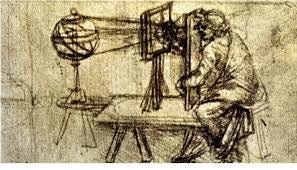
The argument that none of this matters in the end, because the paintings still look the same as they did before Hockney came along, is as problematic as the assertion that Christ’s not really rising from the dead shouldn’t matter to Christians because they’ve still got the wonderful code of conduct that Christianity offers. To a lover of old-master paintings, Hockney’s theory is like suddenly finding out at, say, age 50, that you were adopted. Your adoptive parents may be nice, but you’re still in shock, and you feel a sense of betrayal. Clearly, Vermeer wasn’t cheating in the strict sense (curiously, however, after his death his estate did not list any either lenses or camera obscuras). There were no legal rules for an artist like him to follow. But the revelation about the extent to which he seems to have used the camera obscura makes us feel as if he had cheated, and we’re disappointed, at the very least. An inexorable psychological shift takes place in how we look at and understand the work of old masters when we learn that the artists in question didn’t “eyeball” the world to achieve their images but used the crutch of at least partly tracing projected images. Their achievement is unavoidably ratcheted down a notch.
The argument that painters have always used tools, and that tools are neutral, is a variation of the general thesis that technology is always neutral. But is this true for art? In order physically to scratch out her sentences, Jane Austen was compelled to dip her quill pen, endlessly and carefully, in and out of the inkwell, and to pause frequently to sharpen it. Could it be that in the very act of writing with such a pen—with all the sounds, minuscule drips, and hurried blottings—instead of easily clacking out words on a computer keyboard, Austen found some part of her cogent observations and wry wit?
It’s reasonable to think that the basic tools of the painter—the pencil, brush, straight edge, sighting stick, and pestle with which to grind pigments—might also affect the final paintings. How can we dismiss out of hand the particularity of a painter’s studio and tools, when this is precisely where physicality counts? Even something as seemingly insignificant as the smell of oil paint, as opposed to acrylic paint, might affect a painter. On a larger scale, technological changes obviously have affected the history of painting. Think of the Impressionists painting outdoors. Plein air painting became possible only after the invention of the metal tubes that enabled artists to carry their paint with them into the countryside. Exotic drawing aids, the most famous of which is the drawing grid—a rectangle webbed with wires or threads—have been around for centuries; looking through a drawing grid is a quick way for the artist to be guided in the proportions and location of the subject for projection onto a flat canvas. Even linear perspective itself might be considered a sort of tool—an intellectual tool, as Leonardo argued. (Leonardo also advocated various uses of mirrors by artists.)
Tools are never neutral in art. In fact, they are crucial to understanding the meaning of an art form. The more elaborate the tools used in making a painting, and the more the artist relies on them, the more the marks approach those made by a machine—something extremely unsatisfying to those of us who love and admire a painting as much for the way it is done as for the image itself.
In his famous 1935 essay “The Work of Art in the Age of Mechanical Reproduction,” Walter Benjamin discussed what it is we lose in the modern age of the photographic image. He argued that the ability of a machine to make multiple reproductions sets up a division between the genuine article and the fake, the original and the copy, the authentic and the inauthentic. We can’t help but look at original works of art differently from the way we look at copies of them. There is an aura, or uniqueness, surrounding the original work of art, Benjamin says, and if it’s destroyed it turns art into something for engaging the masses. If old-master painters truly used optics as extensively as Hockney thinks, they were tracing images (arguably a primitive form of mechanical reproduction), and the aura surrounding their work is inevitably diminished.
Art historians’ apparent ignorance of the extent of artists’ use of lenses and how early they began using them, and even the nonchalance of some art historians who intimate that they knew about it all along, threaten to shrink further the already reduced role that stylistic analysis plays within the discipline of art history. If Hockney is right, art historians—for all their looking obsessively at brush strokes, poring over dusty documents, and tracking down the family trees of patrons—simply blew it. In fact, Hockney’s discoveries cast doubt on our already shaky confidence that we can ever know anything of the past. If we missed something as big as van Eyck tracing the chandelier in his jaw-droppingly complex and beautiful painting The Arnolfini Portrait, what else have we missed?
And how did Hockney not miss it? Was he subconsciously looking for lenses because his own art is photographically derived? After all, his work includes a lot of photo-collage. Was he, like the rest of us, monocularly conditioned by seeing thousands of images made with cameras of all sorts? Certainly, Hockney is intensely aware (as Andy Warhol was before him) of the way photography flattens everything in its sight. And Hockney must be aware that there’s more than visual flattening going on in the staggering proliferation of photographically derived images (including video and digital images) in the mass media. Probably, like the rest of us, he’s felt the flattening equality of everythin in our ad-saturated world where we watch something like a sleek blonde shaking out her freshly shampooed tresses followed immediately by footage of a horrible disaster. Perhaps Hockney was, as some panelists suggested, actively searching for projected images. That doesn’t make him mistaken, any more than art historians who’ve recently discovered more and better women painters in art history simply because they were finally looking for them.
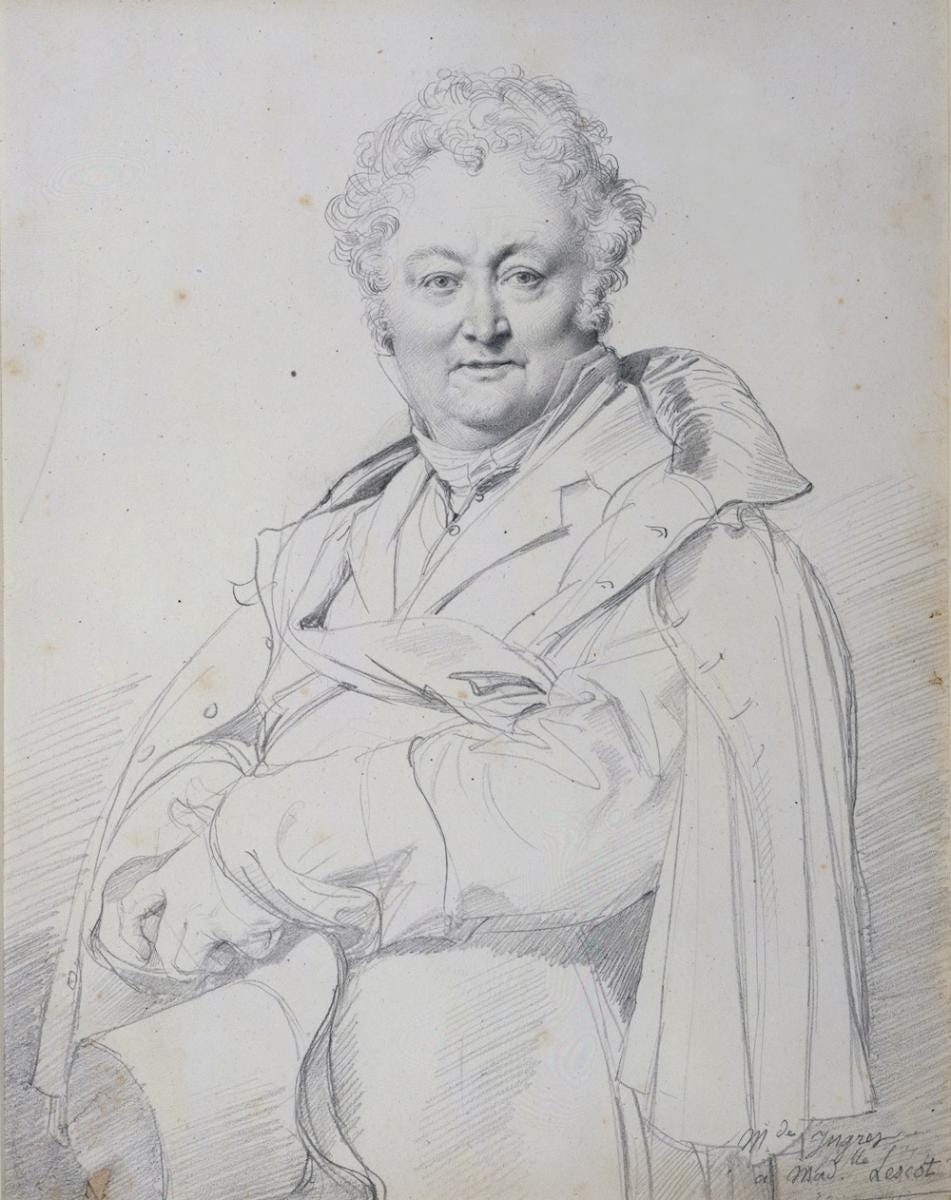
Yet the looking-for approach to history is not without its dangers. In this case, it risks reading into history our own characteristics as moderns, at ease and in love with the photographic image. Hockney’s theory of optics began, in fact, with a hunch that the early 19th-century portrait drawings of Ingres looked peculiarly like the photographically traced images done by Warhol. (I disagree with his observation: Ingres’s line is much more varied than that of Warhol.) Hockney says that when he looked closely at the Ingres drawings, he thought to himself, “I couldn’t do that,” and that this realization led him to look for the lenses that would explain the surety, swiftness, and accuracy of Ingres’s line.
The larger point is that if van Eyck, Vermeer, Ingres, and others were using optical copying tools in making their art, and we didn’t realize it—or the extent of it—before now, then all along we’ve been laboring under unreal expectations of what a great artist can do. We still have Raphael and Rubens and their ilk—those Renaissance artists with the searching kind of line that gropes its way to the final image. But now, as Hockney would have it, a sure line is accomplished with a lens. Hockney’s theory takes something away from what we thought human beings are capable of achieving. Before, when looking at an old master’s masterpiece, we might have thought, “My God, what a marvel this is. I’m so happy somebody in this imperfect, troubled world can do this.” For me, Hockney’s discovery undercuts what I’d thought had been among the highest achievements in painting. I can’t help but feel tremendous loss. And I do not take consolation in Hockney’s argument that the use of lenses actually elevates the artists because it shows how smart they were to figure out how to use them.
It’s significant that at the symposium the word “talent” was uttered only once by a panelist—who was, as it happened, a psychologist. He used it only when referring to a five-year-old drawing prodigy (who in all other respects was profoundly disturbed). Talent has been deemed mostly irrelevant in modern art, and the word is hardly used anymore. Yet it was essential in the premodern days of masters and apprentices. At the symposium, the word of choice favored by all the panelists—whether scientists, art historians, or artists—for what it was, exactly, that the old masters had, was “skill,” not “talent.” But skill is not the same as talent. Someday soon, a computer-driven painting machine will digitally replicate an old-master painting, stroke by stroke, from the canvas up. That machine would be imitating the product of a human “skill” that it would have been programmed to do. At the conference, the critic Susan Sontag suggested that Hockney’s theory contributed to the “Warholization” of art; after all, Warhol famously said that he wanted to be a machine.
In light of Hockney’s revelations, even a genius like van Eyck turns out not to have painted quite like the van Eyck I thought I knew. Like many, I will not apologize for having loved certain paintings at least in part because I thought the artists actually made them from scratch by looking lenslessly out into the world. No matter how we look at it, the tip of the pyramid of human achievement in figurative painting has been lopped off. Truncated like that, the enterprise of the old masters looks a little diminished.
So, what about Als ich can? Although I’m reluctantly persuaded that van Eyck probably started Portrait of a Man by tracing an image reflected from a concave mirror, my own observations tell me he finished it a different way. For all its near-perfection, there’s something strangely wrong about the picture. It has a just-off quality to it—something about the perspective and the eyes of the sitter that doesn’t seem photographic. Somewhere along the line, I suspect van Eyck of cheating on his cheating. I think he might just have sneaked a good long look at the world and his painting, and not merely the lines he traced. Precisely because of its wrong qualities, it is beautiful, and I’ll keep going back to the National Gallery whenever I can to look at Portrait of a Man. But I’ll never again be the innocent that I was that summer so long ago.
Originally published in The Chronicle Review of The Chronicle of Higher Education, 11 January 2002 ©Laurie Fendrich, All Rights Reserved. Laurie Fendrich is an artist and writer in Lakeville, CT.
 | A guest post by
|
This is sort of like an intellectual rabbit hole. Interesting, well written and informed but it's like a classroom lecture. Good as far as it goes. In no way does it influence how I look at Van Eyck, Vermeer and the others who still astonish me with their art, not their clever use of optics
Wow! Thanks for posting. Amazingly cogent argument. Still, I think it reflects LF's need to satisfy her own expectations rather than a "problem" in. painting. I'm satisfied with what I see, regardless of how it was made. Indeed, the Ingres portrait does look rather false, and we believe that many Old Masters achieved equally wonderous results without optics. I happen to have a copy of Hockney's book, which I'll review. But now I'm a major LF fan.